Imagine an employee completing mandatory compliance training not because they have to—but because they genuinely want to. This isn’t fantasy; it’s the power of gamification in corporate e-learning.
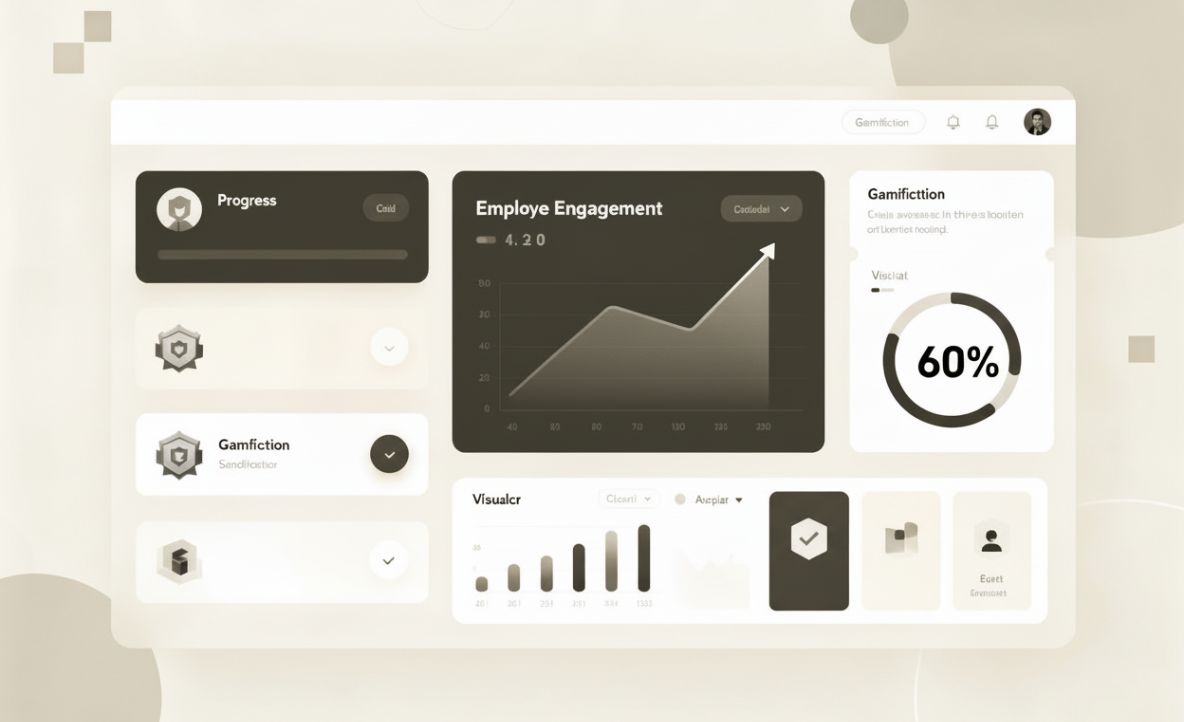
Traditional corporate training suffers from a persistent problem: disengagement. Employees view training as checkbox compliance rather than value-adding development. But here’s the compelling data: organizations implementing gamified training see a 60% boost in employee engagement, 25% improvement in knowledge retention, and 30% higher course completion rates.
For Indian companies managing diverse workforces across multiple locations with varying motivation levels, gamification transforms training from a perceived burden into an engaging experience that drives measurable business results.
What is Gamification in E-Learning?
Gamification integrates game mechanics—elements that make games addictive and engaging—into non-game contexts like corporate training. Common gamification elements include:
- Points & Scoring Systems: Employees earn points for completing modules, passing assessments, and achieving milestones
- Badges & Certificates: Visual achievements that recognize accomplishment and encourage continued engagement
- Leaderboards: Competitive rankings that motivate high performance (friendly competition without harming collaboration)
- Progress Bars & Level Systems: Visual representations of advancement that create momentum and sense of achievement
- Challenges & Quests: Time-bound, objective-driven tasks that structure learning around exciting missions
- Rewards & Incentives: Tangible or intangible rewards for reaching goals—recognition, privileges, or professional benefits
- Story-Based Narratives: Learning embedded within compelling narratives that provide context and motivation
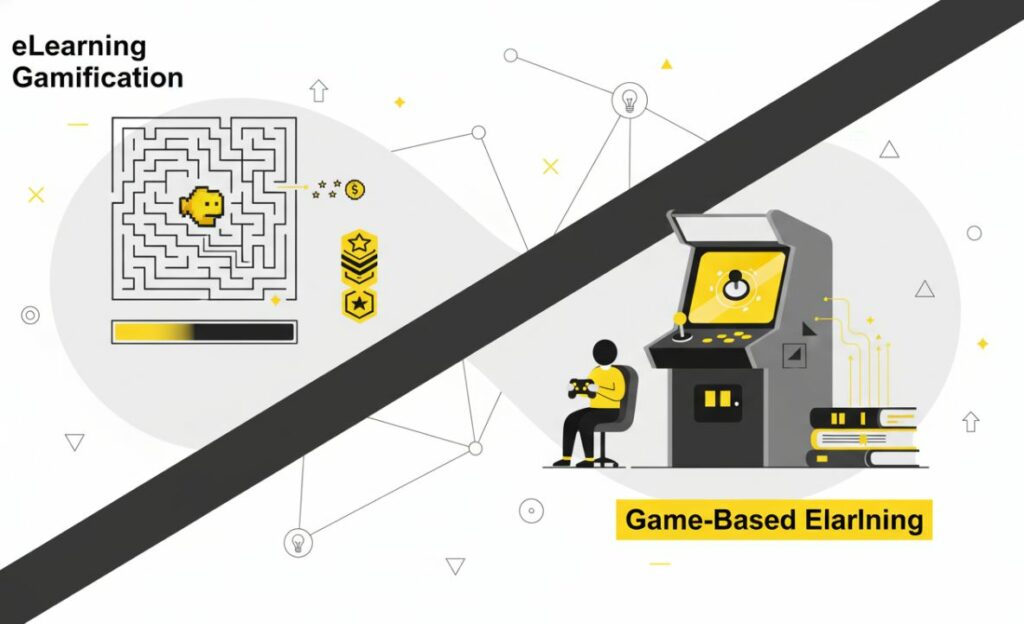
Unlike pure game-based learning (which uses full games), gamification strategically applies game principles to enhance existing training without overshadowing learning objectives.
Why Gamification Works: The Science Behind Engagement
The human brain is wired for competition, achievement, and recognition. Gamification taps into these psychological drivers:
Motivation Theory: Gamification addresses three core motivational needs: autonomy (choice in learning path), competence (achievable challenges with clear feedback), and relatedness (social comparison through leaderboards).
Dopamine Release: Successfully completing challenges and earning rewards triggers dopamine release—the neurochemical associated with pleasure and reinforcement. This creates positive associations with learning, increasing engagement and retention.
Progress Visualization: When employees see tangible progress (level advancement, points accumulation, badge collection), they experience psychological satisfaction that drives continued engagement.
Social Influence: Leaderboards leverage social motivation. Even low-competitive employees often increase effort when visible to peers, particularly in Indian workplace cultures valuing collective achievement.
Proven Benefits: What Gamification Delivers for Indian Organizations
1. Dramatically Increased Engagement
Before gamification, average e-learning completion rates hovered at 40%. Post-implementation, organizations report 65-75% completion rates. Employees spend 40% more time in training when gamification elements are present. For mandatory compliance training—historically the most disengaging—gamification makes the difference between checkbox compliance and genuine learning.
2. Improved Knowledge Retention
Gamification’s interactive nature, immediate feedback, and reward systems strengthen memory encoding. Employees retain 85% of gamified content versus 60% from traditional methods. This matters profoundly for compliance training, safety protocols, and role-critical knowledge where mistakes carry consequences.
3. Accelerated Time-to-Competency
Gamified learning feels purposeful rather than burdensome. Employees complete modules faster while maintaining (or improving) knowledge quality. What took 10 weeks with traditional methods often completes in 6 weeks with gamification—accelerating productivity gains and reducing time away from core work.
4. Reduced Training Costs
Higher completion rates, better retention, and faster time-to-competency combine to reduce per-employee training costs by 20-35%. For organizations training thousands of employees annually, these savings translate to millions of rupees.
5. Improved Employee Satisfaction and Culture
Employees perceive gamified training as more enjoyable and relevant. This positive perception extends beyond training—improving overall employee satisfaction and positioning the organization as forward-thinking and employee-centric. For Indian companies competing for talent, this cultural benefit is significant.
6. Data-Rich Performance Insights
Gamification platforms generate rich behavioral data. L&D leaders see exactly which content employees find engaging, where learning struggles occur, which game mechanics drive highest participation, and how individual learning patterns vary. This intelligence informs continuous training improvement.
Gamification in Practice: Sector-Specific Applications
BFSI Sector (Banking & Financial Services): Regulatory compliance training becomes engaging through point systems, level advancement, and competitive leaderboards. Employees compete to achieve “Compliance Expert” badges, transforming obligation into professional accomplishment.
Manufacturing & Operations: Safety training gamification dramatically improves adherence. Employees earn safety badges, accumulate points for incident-free periods, and advance through safety mastery levels—reinforcing critical safety behaviors through repeated engagement.
IT & Software Companies: Technical upskilling becomes a competitive pursuit. Development teams earn “Mastery Badges” for language proficiencies, architectural knowledge, or tool expertise. Leaderboards celebrate learning achievement alongside work performance.
Pharmaceutical & Healthcare: Complex regulatory and procedural knowledge becomes more memorable through gamified scenarios and challenges. Quiz-based games reinforce pharmaceutical protocols, patient safety procedures, and compliance requirements with immediate, engaging feedback.
Retail & Hospitality: Product knowledge training transforms from memorization exercise to engaging competition. Staff members compete on product knowledge leaderboards, earn badges for demonstrating expertise, and receive recognition—driving service quality improvements.
Implementation Roadmap: Making Gamification Work for Your Organization
Phase 1: Define Clear Learning Objectives
Gamification amplifies engagement but must serve specific learning goals. Before implementing, clarify:
- What knowledge or skills must employees master?
- What behavioral changes does the organization need?
- How will success be measured?
- What are realistic engagement targets?
Phase 2: Select Appropriate Game Mechanics
Not all employees respond equally to all mechanics. High-achievers thrive with leaderboards; collaborative employees prefer group challenges. Successful implementations typically use a balanced game mechanic portfolio:
- 40% points and progression systems (appeals to intrinsically motivated learners)
- 30% achievement badges and recognition (appeals to accomplishment-oriented learners)
- 20% leaderboards and competition (appeals to competitive learners)
- 10% narrative and storytelling elements (appeals to exploratory learners)
Phase 3: Embed Meaningful Feedback
Game mechanics without feedback feel hollow. Implement:
- Immediate feedback on quiz responses and challenges (within seconds, not days)
- Progress visualization showing advancement, points, levels, and badges
- Corrective feedback explaining why answers are wrong and guiding toward correct understanding
- Achievement announcements celebrating completed levels and badges with peer visibility
Phase 4: Avoid Gamification Pitfalls
Over-Gamification: Too many game mechanics create distraction rather than engagement. The training content must remain primary; gamification should enhance, not overshadow.
Misaligned Incentives: If leaderboard placement depends on speed rather than comprehension, employees rush through content without learning. Ensure game mechanics incentivize desired learning behaviors.
Ignoring Diverse Motivation Styles: Some employees feel pressured by public leaderboards. Provide options—private progress tracking for less competitive employees, public recognition for competitive ones.
Treating Gamification as “Magic Solution”: Poorly designed content with excellent gamification still produces poor learning. Gamification enhances good instructional design; it cannot redeem bad content.
Phase 5: Measure and Optimize
Track key metrics:
- Engagement metrics: Time spent, completion rates, module revisits
- Learning metrics: Assessment scores, knowledge retention tests, performance improvements
- Behavioral metrics: Skill application in job roles, safety incident reduction, compliance adherence
- Business metrics: Training ROI, productivity improvements, employee retention
Use this data to continuously refine game mechanics, content, and overall design.
Real-World Success: What Indian Organizations Are Achieving
A mid-sized IT services company implemented gamified technical training for 2,000 developers. Results: 68% completion rate (vs. 42% baseline), 73% score improvement on competency assessments, and average time-to-skill-mastery reduced from 12 weeks to 8 weeks. Importantly, employee survey satisfaction jumped from 3.2/5 to 4.6/5—transforming perception of training from burden to valued development opportunity.
A pharmaceutical company deployed gamified compliance training across 5,000 employees across 15 manufacturing facilities. Within six months: compliance assessment scores improved from 64% to 89%, safety incidents decreased 22%, and training completion jumped from 51% to 87%. The company estimated annual risk reduction value at ₹4.2 crore.
Conclusion: Gamification as Strategic Training Innovation
The corporate training landscape has fundamentally shifted. Engagement is no longer optional—it’s competitive necessity. Organizations unable to engage employees in training cannot develop the workforce quality required for competitive advantage.
Gamification isn’t gimmickry; it’s a scientifically-grounded approach leveraging human psychology and motivational principles to align training delivery with how people actually learn and stay engaged. For Indian organizations managing diverse, distributed workforces with varying motivation levels, gamification transforms training from compliance checkbox to strategic competitive advantage.
The companies leading your industries likely already use gamification. The question isn’t whether gamification works—evidence overwhelmingly confirms it does—but whether your organization will lead in adopting this approach or continue falling behind competitors who are.
Ready to transform your training engagement? Garage Productions specializes in designing and implementing gamified e-learning solutions that deliver measurable engagement and learning outcomes. Let’s discuss how gamification can revolutionize your corporate training program and drive the employee engagement and skill development your organization needs to thrive.
——————————————————————————————————————————————————————————————————————————————————————————————
Multilingual E-Learning Content: Reaching India’s Diverse Workforce in Hindi, Bengali, and Regional Languages
Meta Title: Multilingual E-Learning India | Regional Language Training Content 2025
Meta Description: Discover how multilingual e-learning in Hindi, Bengali, and regional languages increases engagement and reach in India. Localization strategies for pan-India enterprises.
URL Slug: /multilingual-elearning-india-regional-languages
Primary Keywords: Multilingual e-learning India, Hindi content learning, Bengali e-learning, regional language training, localized training content
Long-tail Keywords: E-learning translation services India, multilingual LMS India, culturally adapted training content, regional language corporate training
Introduction: The Untapped Potential of India’s Regional Language Speakers
Here’s a critical insight many Indian organizations miss: 55% of India’s workforce—approximately 300 million people—prefer learning in regional languages rather than English. Yet, most corporate training is delivered exclusively in English, creating an enormous engagement and accessibility gap.
India has 22 officially recognized languages plus hundreds of dialects. Hindi is the mother tongue of 43% of Indians; Bengali accounts for 10%; followed by Telugu, Marathi, Tamil, and others. When organizations deliver training only in English, they effectively exclude hundreds of millions of potential learners while dramatically limiting engagement among those who do attempt English-language content.
The numbers are staggering: Companies implementing multilingual training across India report 67% higher engagement rates, 45% better knowledge retention, and 52% higher course completion rates among regional language learners compared to English-only counterparts.
For pan-India enterprises, multinational corporations operating across India, and organizations with frontline workforces spanning diverse regions, multilingual e-learning isn’t a nice-to-have feature—it’s competitive necessity.
The Business Case: Why Multilingual E-Learning Matters
1. Dramatically Expanded Reach and Accessibility
Most Indian employees don’t speak English fluently outside professional contexts. When training is English-only, employees struggle to concentrate on content while simultaneously translating language in their minds. Comprehension suffers; retention plummets.
Regional language training removes this cognitive load. Learners engage with content in their native language, understanding complex concepts rather than wrestling with unfamiliar terminology. The result: broader participation, better learning outcomes, and training that actually reaches your entire workforce rather than English-proficient segments.
2. Significantly Improved Learning Outcomes
Research on multilingual learning is unequivocal: people learn better in their first language. Retention improves 35-45% when content is in the learner’s native language. For critical knowledge—safety protocols, compliance requirements, technical procedures—this improvement directly impacts performance and risk reduction.
3. Enhanced Employee Satisfaction and Inclusion
Providing training in employees’ native language sends a powerful message: “Your language, culture, and accessibility matter to us.” This drives employee satisfaction, belonging, and organizational commitment. Indian companies prioritizing multilingual training report 38% higher employee engagement scores and measurably improved retention, particularly among frontline workers.
4. Compliance and Risk Reduction
In manufacturing, pharmaceuticals, and BFSI sectors, regulatory compliance training must ensure genuine understanding across all employees. When a frontline worker misunderstands a safety protocol because it was explained in non-native English, consequences can be severe. Multilingual compliance training ensures clear, unambiguous communication of critical safety and regulatory requirements across your entire workforce.
5. Competitive Advantage in Talent Attraction and Retention
Forward-thinking organizations offering multilingual training attract talent from broader geographic regions and socioeconomic backgrounds. For manufacturing and operations-heavy companies, this access to wider talent pools significantly improves recruitment and reduces hiring costs.
The Challenge: Effective Multilingual Content Development
Creating truly effective multilingual e-learning is more complex than simple translation. Poor multilingual implementation can backfire, creating content that is technically translated but culturally inappropriate, contextually irrelevant, or linguistically awkward.
Translation vs. Localization: A Critical Distinction
Translation converts English text into regional languages word-for-word. This approach often produces awkward, confusing content that learners find frustrating.
Localization adapts content for regional languages while considering cultural context, local examples, regional regulatory requirements, and cultural norms. A localized module about customer service excellence in Hindi won’t just translate English examples—it will include examples resonating with Hindi-speaking employees’ work experiences and cultural values.
Effective multilingual e-learning requires localization, not mere translation.
Key Challenges in Multilingual E-Learning:
1. Linguistic Complexity: Hindi, Bengali, and other Indian languages have grammatical structures fundamentally different from English. Direct translation often produces incomprehensible results. Professional linguists familiar with technical terminology are essential.
2. Cultural Adaptation: A safety training scenario perfectly suitable for English-speaking urban professionals may need significant cultural adaptation for regional language learners in different geographic contexts.
3. Visual and Symbolic Considerations: Icons, images, and symbols carrying specific meanings in one culture may confuse or offend in another. Effective localization reviews all visual elements for cultural appropriateness.
4. Maintenance and Version Control: Managing content in multiple languages creates complexity—when English content updates, all translated versions must update simultaneously. Efficient processes and robust content management systems are essential.
5. Quality Assurance: Native speakers fluent in both the language and the subject matter must review all content to ensure linguistic accuracy, cultural appropriateness, and technical correctness.
Implementation Strategy: Building Effective Multilingual E-Learning
Phase 1: Strategic Language Selection
Start by identifying which languages reach the highest percentage of your target workforce:
- Hindi: Prioritize if targeting pan-India reach. Hindi speakers represent 43% of India’s population and span diverse regions.
- Bengali: Essential for Eastern India operations (10% population, concentrated in West Bengal, Assam, Jharkhand)
- Telugu: Critical for Southern operations and tech hubs (8% population, strong in Telangana, Andhra Pradesh)
- Marathi: Important for Western India, especially Maharashtra operations (7% population)
- Tamil: Essential for Tamil Nadu and Southern operations (6% population)
- Other Regional Languages: Based on your specific geographic footprint and workforce distribution
Don’t attempt to translate into all 22 official languages immediately. Start strategically with languages covering 80% of your workforce.
Phase 2: Professional Content Localization
Partner with professional localization providers specializing in corporate e-learning:
Step 1: Subject Matter Expert Review
Your internal SME and the localization team collaborate to identify culture-specific examples, locally relevant scenarios, and region-specific regulatory or procedural requirements to incorporate into regional language content.
Step 2: Professional Translation by Specialists
Never use machine translation alone. Hire native speakers with subject matter expertise in your industry to translate content. A translator familiar with pharmaceutical protocols will produce superior pharmaceutical training translations compared to a generic translator.
Step 3: Cultural Review
Have culturally knowledgeable reviewers examine all content for appropriateness, relevance, and cultural sensitivity. They’ll identify and suggest alternatives to examples, metaphors, or scenarios that might confuse or offend.
Step 4: Quality Assurance Testing
Native speakers unfamiliar with the original English content review translated content to verify clarity, appropriate terminology, and overall comprehensibility. If native speakers unfamiliar with the content understand it, translation quality is confirmed.
Step 5: Learner Testing
Conduct pilot testing with actual learners from your target region before full rollout. Their feedback on clarity, relevance, and comprehensibility informs final refinements.
Phase 3: Leveraging Technology for Scalability
Modern LMS platforms support multilingual content management:
- Centralized content management: Manage English master content centrally; translations branch from this source, reducing duplication and version control issues.
- Automatic language detection: Platforms can detect user language preferences and automatically serve appropriate language versions.
- Multilingual assessment: Assessments automatically appear in learner’s language preference, ensuring comprehension while maintaining scoring standardization.
- Reporting and analytics: Track learning metrics by language, identifying whether particular language cohorts struggle with specific content—informing targeted improvements.
Phase 4: Continuous Improvement
Monitor learner feedback and performance by language:
- Which language learners complete courses fastest? Why?
- Where do learners across all languages struggle most?
- Are any language groups underperforming? Why?
- How do learner satisfaction scores vary by language?
Use this intelligence to continuously refine translations, update cultural examples, and improve overall content quality.
Real-World Success: Multilingual E-Learning Impact
A manufacturing company with operations across India implemented multilingual safety training in Hindi, Telugu, and Tamil. Results: safety incident rates decreased 31% in the first year; course completion rates jumped from 48% (English-only) to 82% across all language groups; and employee satisfaction with training increased from 3.1/5 to 4.4/5. Most significantly, near-miss reporting increased (indicating employees now understood procedures well enough to recognize and report safety issues), a leading indicator of superior safety culture.
An IT services company delivering multilingual upskilling to BPO employees saw 58% higher course completion rates and 44% better assessment scores when training was offered in regional languages compared to English-only options. Employees rated the training significantly more relevant and valuable.
Key Metrics: Measuring Multilingual E-Learning Success
Track these metrics to assess multilingual program effectiveness:
| Metric | Baseline (English-only) | Target (Multilingual) | Impact |
| Course Completion Rate | 48-55% | 70-85% | 35-50% improvement |
| Assessment Scores | 62-68% | 78-88% | 20-26% improvement |
| Knowledge Retention (30-day) | 55% | 75-80% | 25-35% improvement |
| Employee Satisfaction | 3.2/5 | 4.2-4.6/5 | 30-44% improvement |
| Time-to-Competency | 8-10 weeks | 5-7 weeks | 30-40% acceleration |
Conclusion: Multilingual as Standard Operating Procedure
India’s workforce is multilingual. Organizations delivering English-only training are leaving enormous potential on the table—both in terms of learner reach and learning effectiveness. The companies leading your industries already recognize this and are investing in multilingual e-learning.
Multilingual training isn’t complexity for complexity’s sake. It’s strategic investment in accessibility, learning effectiveness, and inclusion. For Indian organizations operating across multiple regions, serving diverse workforce demographics, or competing for talent, multilingual e-learning represents competitive advantage and operational excellence.
The question is no longer whether to offer multilingual training, but how quickly you can transition from English-only to a strategically multilingual approach that serves your entire workforce effectively.
Ready to unlock the potential of India’s regional language learners? Garage Productions specializes in multilingual content development and localization for corporate e-learning. We work with professional linguists, cultural experts, and your subject matter specialists to create genuinely localized content that resonates with learners across India’s diverse regions. Let’s discuss how multilingual e-learning can expand your reach, improve your learning outcomes, and demonstrate organizational commitment to inclusion and accessibility.